

911 & emergency calling
The feature you hope nobody ever tests
Emergency calling is the one part of a phone system where “mostly working” is the same as broken. It is also the part that is easiest to get wrong without anyone noticing, because nothing complains until the day it matters.

What the law actually asks for
Two federal rules govern business phone systems in the United States. Between them they ask for four things.
Kari’s Law
Named for Kari Hunt, who was killed in a motel room in 2013 while her nine‑year‑old daughter dialed 911 four times. The calls never connected, because the phone system required a 9 first and nobody had told her.
- Direct dialing. 911 must work from any phone with no prefix, no access code, nothing to remember.
- On‑site notification. Somebody at the location must be told a 911 call was made, so they can meet responders at the door.
RAY BAUM’S Act
Addresses the problem that a phone can be anywhere. A call that reaches the right dispatcher with the wrong address sends help to a building the caller is not in.
- Dispatchable location. Dispatch must receive an address specific enough to actually find the caller.
- A callback number. If the call drops, the dispatcher must be able to call back.
How Corinne does it
Six decisions that make the difference
911 is matched before everything else
Before the account’s status is checked. Before an extension that happens to be numbered 911. Before the protections that throttle suspicious traffic at the edge of the network. That last one is a real failure mode. A busy office behind a single internet connection can look like an attack, and a system that bans it also bans its 911 calls.
The number sent is mapped to your address
The emergency call presents a number your carrier has on file against your registered street address, rather than the caller’s own extension or a number that resolves to our data center. The dispatcher sees where to send help.
A failure to find your address never blocks the call
If the location cannot be resolved for any reason, the call is still placed and an alert is raised for us to deal with. A 911 call with an imperfect address is enormously better than no 911 call, and the temptation to fail safely in the wrong direction here is exactly the trap.
It keeps working when other things break
We tested this rather than assuming it: with the platform’s database deliberately stopped, an emergency call still routed and still bridged, while ordinary calls carried on from cached configuration. An outage in the boring parts must not take 911 with it.
Emergency addresses are never served stale
Most lookups in Corinne fall back to the last known good answer when something is slow — it is why a call survives a hiccup. Emergency location is the deliberate exception. An address that was right last month is not an address; it is a wrong turn.
The record is frozen and written once
Every emergency call writes a permanent record containing a snapshot of the address transmitted at that moment, not a pointer to an address record somebody may edit later. One call produces exactly one record, and nothing can rewrite what it says.
Worth knowing
One limitation, stated plainly
Corinne dispatches a 911 call to your company’s registered address. It does not currently work out which building a phone is sitting in by itself.
For a business in one building, that is exactly right and there is nothing to think about. If you occupy more than one building under a single account, tell us before you sign. We handle that by giving each site its own configuration and its own registered address, but it has to be set up deliberately. The failure mode is sending responders to your other office.
We are telling you this because it is the kind of detail that does not appear on a comparison chart and matters enormously on one particular day.
What happens when someone dials 911
The call goes, immediately
No prefix, no menu, no delay while anything else is evaluated.
Your people are told
The contacts you nominate are notified that a 911 call was placed, from which extension, and when, so someone can open the door.
Dispatch sees your address
The number presented maps, at your carrier, to the street address on file for that location.
The record is written
Permanently, with the address exactly as it was transmitted, whatever anyone edits afterwards.
In the console
What you can check for yourself
Your registered locations, whether the carrier has validated each one, the callback number attached to it, and who gets told the moment 911 is dialed.
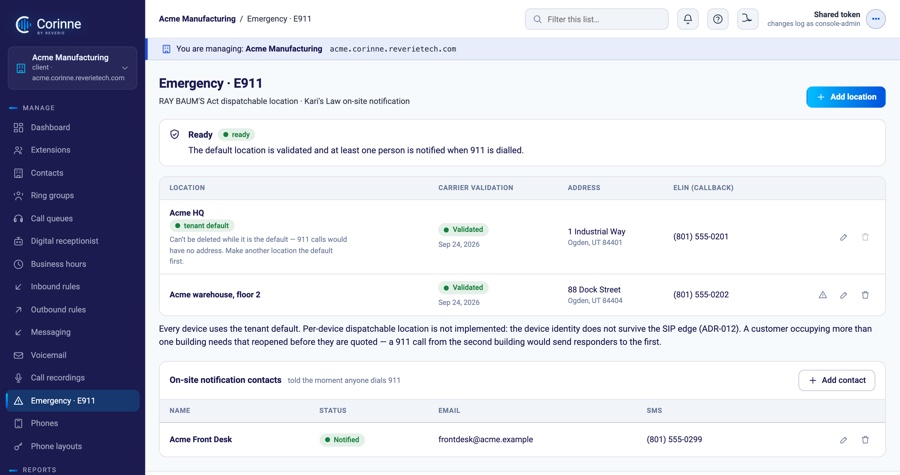
If a location is not validated, or nobody is set to be notified, this page says so rather than showing a green tick.
Questions people actually ask
Do we still need to tell you when we move office?
What about someone working from home on a Corinne phone?
Can we test it?
Is the on-site notification an email, or something louder?
What if our internet is down?
Talk to us about your sites
Especially if you have more than one. It takes ten minutes to get right at the start and is a serious problem to discover later.