

Business texting
Text from the number they already know
Customers text. They text the number on your van, your invoice and your website, and if that number cannot receive a message the reply never happens. Corinne makes your main business number work both ways.
What you get
A shared inbox, not a personal phone
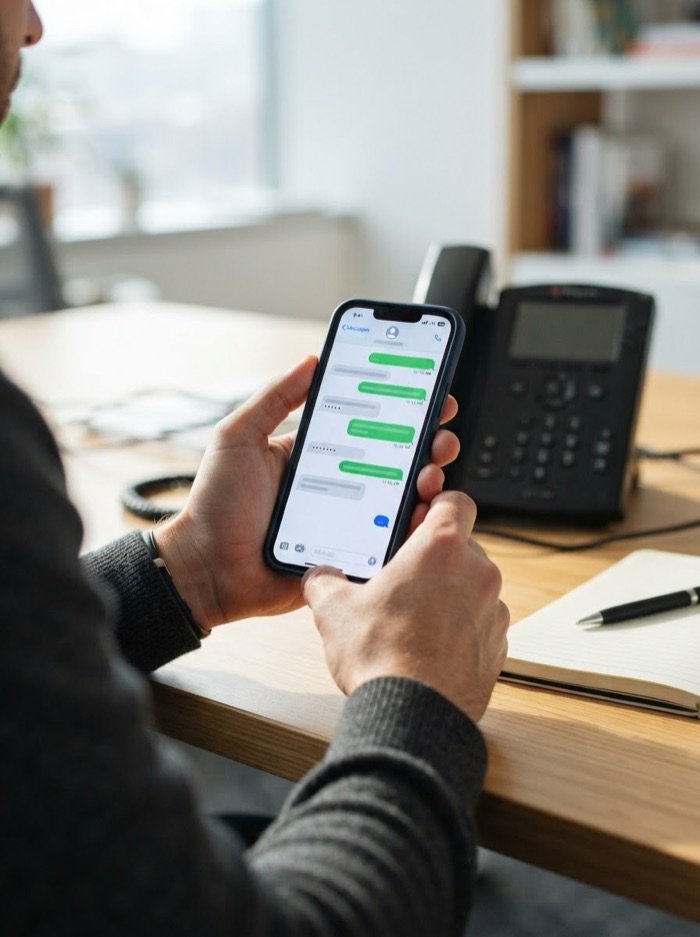
Messages to your business number arrive in the portal as conversations, and replies go out from that same number. Nobody has to hand out a cell phone, and a conversation does not vanish when the person who had it is on holiday.
- Two‑way SMS from your business number, threaded by contact
- MMS — a customer can send you a photo of the part, the meter, the damage
- Shared visibility, so a colleague can pick up a thread
- Send to several people at once where you have the right to, with each recipient checked individually
- A record of every message, sent or blocked, with the reason
Where texting earns its keep
Appointment reminders that people actually read. Confirming an engineer is on the way. Sending a quote reference. Answering “are you open?” without a phone call. Reaching someone who cannot take a call at work.
It is also the quiet reason businesses lose inquiries: a customer texts, hears nothing back, and calls a competitor who answered.
The part nobody warns you about
Business texting is registered, not just switched on
In the United States, texting from a business number to mobile phones runs through a registration system the carriers operate. An unregistered business sending texts does not get an error — the messages are simply filtered out, silently, and you find out when a customer says they never got it.
We handle the registration
Reverie Tech registers your business and your messaging with the carriers on your behalf, and tracks the result. You do not have to learn what any of the acronyms mean.
It stays off until it is approved
Sending is disabled until your registration is actually approved and your number is attached to it. That prevents the worst outcome: believing you are texting customers while every message is being discarded.
STOP always wins
When someone replies STOP, they are added to a do‑not‑contact list that the sending business cannot override or delete. Honouring an opt‑out is not a setting we let anyone turn off.
How the guard rails work
Checked in order, every time
Every outgoing message passes the same sequence of checks. If any one fails, the message is not sent and the reason is recorded, so you can see what happened rather than guessing.
- Is texting switched on for this business?
- For a bulk send, is bulk messaging separately allowed?
- Is the number sending it registered, and is the registration approved?
- Has this recipient opted out?
- For a marketing message, is there consent on file for this recipient?
- Is the business inside the daily volume the carrier granted it?
Every attempt is recorded whether it was sent or blocked, so the log answers “did we text this customer?” completely.
Worth knowing before you plan a campaign
- Registration takes time. Approval is the carriers’ decision, not ours, and it is measured in days rather than minutes. Start it early.
- They set your limits. How many messages a second and a day you may send is granted by the carriers based on your registration. We enforce what they granted; we cannot raise it.
- Marketing is a different category from appointment reminders and service notices, with stricter consent requirements.
- Each business registers separately, so one customer’s problem does not become everyone’s.
Start the registration early
It is the longest lead time in a phone migration and the easiest one to leave until last. Tell us you want texting and we will begin it on day one.